Pearson Edexcel · A-Level · History
Course version: 9HI0 · Version from Sept 2015
Britain: losing and gaining an empire, 1763–1914 - 1 The loss of the…
Full specification wording
Paper 3, Option 35.1: Britain: losing and gaining an empire, 1763–1914 - 1 The loss of the American colonies, 1770–83: Tensions between colonists and the British, 1770–75: the issue of custom collection and tea duties, including the Boston Tea Party; the Coercive Acts 1774 and their impact.
After 1770, British attempts to raise revenue and control trade through customs and tea duties provoked colonial resistance.
Checked against the Pearson Edexcel 9HI0 specification (opens in a new tab) on .
- Point 1 of 3
- 4 key terms
Study notes
From the checked teaching notes for this specification point.
The idea
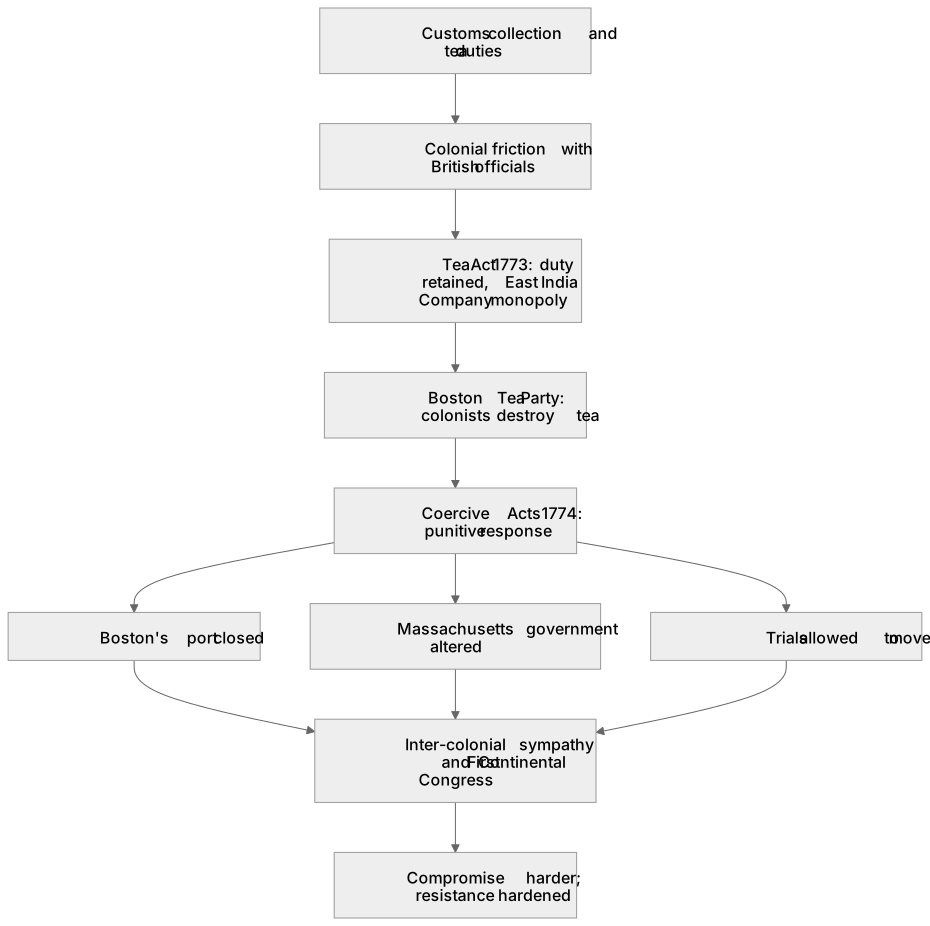
After 1770, British attempts to raise revenue and control trade through customs and tea duties provoked colonial resistance. The Tea Act of 1773 retained the duty while granting the East India Company a monopoly, prompting the Boston Tea Party, where colonists destroyed tea rather than allow its landing and sale. Britain responded with the Coercive Acts of 1774, closing Boston's port, altering Massachusetts government and allowing trials to move. These measures were intended to isolate and punish Massachusetts, but instead they generated inter-colonial sympathy, strengthened the First Continental Congress and made compromise harder. The crisis shows how commercial regulation, taxation and coercion interacted to push the colonies towards revolution.
What earns the marks
- Explains how customs collection and tea duties created friction between colonists and British officials.
- Describes the Boston Tea Party as a direct response to the Tea Act and the monopoly granted to the East India Company.
- Analyses the Coercive Acts 1774 as a punitive response to the destruction of tea in Boston.
- Assesses the impact of the Coercive Acts, including colonial unity, the First Continental Congress and the hardening of resistance.
- Links economic grievances to political arguments about representation and consent.
Common mistakes and how to put them right
Treating the Boston Tea Party as a simple riot rather than a calculated protest against the Tea Act and the duty.
Put it right: Explain the political and commercial motives behind the destruction of the tea.
Assuming the Coercive Acts only affected Boston.
Put it right: Note that they altered Massachusetts government and allowed trials to be moved, with wider implications for all colonies.
Confusing the Tea Act with the Townshend duties.
Put it right: Distinguish the 1773 Tea Act, which retained the tea duty and gave the East India Company a monopoly, from earlier revenue measures.
Exam tips
- Use precise dates and names, such as the Tea Act 1773 and the Coercive Acts 1774, to anchor your argument.
- Explain causation rather than listing events: show how customs enforcement led to protest and how protest led to coercion.
- When assessing impact, consider both intended and unintended consequences for Britain and the colonies.
Try the lesson
The start of the Paper 3, Option 35.1: Britain: losing and gaining an empire, 1763–1914 - 1 The loss of the American colonies, 1770–83: Tensions between colonists and the British, 1770–75: the issue of custom collection and tea duties, including the Boston Tea Party; the Coercive Acts 1774 and their impact. lesson, made from checked teaching notes for this specification point.
Have a go first
Which British legislation of 1773 granted the East India Company a monopoly on the sale of tea in the American colonies?
Listen
After 1770, British attempts to raise revenue and control trade through customs and tea duties provoked colonial resistance. The Tea Act of 1773 retained the duty while granting the East India Company a monopoly, prompting the Boston Tea Party, where colonists destroyed tea rather than allow its landing and sale. Britain responded with the Coercive Acts of 1774, closing Boston's port, altering Massachusetts government and allowing trials to move. These measures were intended to isolate and punish Massachusetts, but instead they generated inter-colonial sympathy, strengthened the First Continental Congress and made compromise harder. The crisis shows how commercial regulation, taxation and coercion interacted to push the colonies towards revolution. A strong answer earns marks for these points. Explains how customs collection and tea duties created friction between colonists and British officials. Describes the Boston Tea Party as a direct response to the Tea Act and the monopoly granted to the East India Company. Analyses the Coercive Acts 1774 as a punitive response to the destruction of tea in Boston. Assesses the impact of the Coercive Acts, including colonial unity, the First Continental Congress and the hardening of resistance. A common slip: Treating the Boston Tea Party as a simple riot rather than a calculated protest against the Tea Act and the duty. Instead, explain the political and commercial motives behind the destruction of the tea. Exam tip: Use precise dates and names, such as the Tea Act 1773 and the Coercive Acts 1774, to anchor your argument.
See it
Key words
Say what each word means before you turn the card.
Taxation and representation
Try answering aloud or in your head before turning the card.
Commercial regulation and empire
Try answering aloud or in your head before turning the card.
Colonial resistance and protest
Try answering aloud or in your head before turning the card.
Coercion and escalation
Try answering aloud or in your head before turning the card.
See every definition
- Taxation and representation
- Economic grievances over customs and tea duties linked to political arguments about representation and consent.
- Commercial regulation and empire
- British attempts to raise revenue and control trade through customs and tea duties provoked colonial resistance.
- Colonial resistance and protest
- Colonists destroyed tea rather than allow its landing and sale, a calculated protest against the Tea Act and the duty.
- Coercion and escalation
- The Coercive Acts were intended to isolate and punish Massachusetts but generated inter-colonial sympathy and made compromise harder.
Label the diagram
Some boxes have lost their names. Pick the right name for each number.
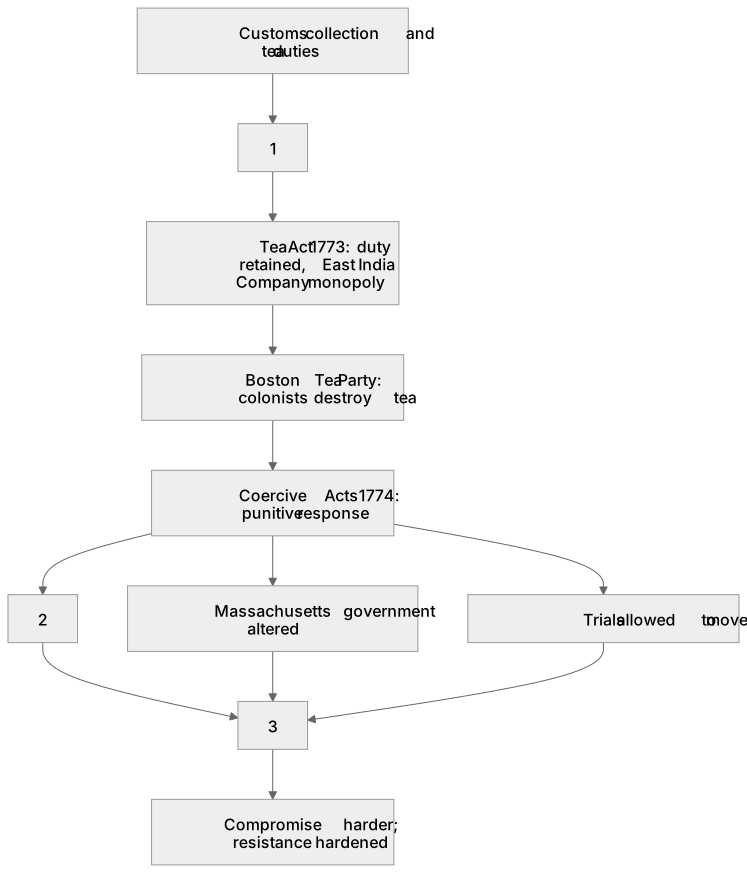
1Box 1
2Box 2
3Box 3
There is more to this lesson
The full lesson goes on to check your understanding and help you earn the marks. Create a free account to carry on, with your progress saved.
A week of Premium from your first lesson · Then the free plan continues · No card, no charge
Test your understanding of Paper 3, Option 35.1: Britain: losing and gaining an empire, 1763–1914 - 1 The loss of the American colonies, 1770–83: Tensions between colonists and the British, 1770–75: the issue of custom collection and tea duties, including the Boston Tea Party; the Coercive Acts 1774 and their impact.
Active recall beats re-reading. Take an instant quiz now to test what you’ve learned and lock it into long-term memory.
A week of Premium from your first lesson · Then the free plan continues · No card, no charge